Twenty year old Javokhir Sindarov wins the Candidates Tournament with impressive results, earning the right to play Gukesh in the World Chess Championship.
2026-04-15


2026-04-13
Sindarov Impresses Even Magnus
https://www.youtube.com/watch?v=FOAOXPWKnnw
Sindarov has been doing very well in the World Championship Candidates tournament.
Sindarov has been doing very well in the World Championship Candidates tournament.
2026-04-01
My Chess Tactics Study
For roughly 30 years, I have advocated on my chess lesson website that people should study tactics for 30 minutes per day. I've always qualified this by saying that if someone doesn't have time for 30 minutes, then 10 to 20 minutes is still beneficial—consistency is the most important factor.
At first, I was very good at following my own advice. Studying 30 minutes per day worked very well for me. I seemed to reach my peak chess strength around 2003, when I was 43. During that time, I drew against Igor Ivanov in a Nevada tournament and finished second, ahead of four Experts.
However, after that event, I went through a 20-year period where I was very inconsistent with tactics study. As I got older, I increasingly felt that I was past my peak. I began to think that I was no longer Expert strength, but rather a strong Class A player.
A little over 13 months ago, I lost four out of five games to a member of my chess club rated around 2000. I didn't think I should lose by that margin, so I decided to do something about it. Since then, I have been averaging about an hour of tactics study per day. Because I am retired, I have the luxury of starting each day with an hour of tactics and a large cup of coffee. Since beginning this recent push, I have consistently won the majority of games against that same player, sometimes by a large margin.
The reason I am doing 60 minutes instead of 30 is that I am older now. I feel like I am fighting entropy. When I was younger, 30 minutes was enough.
So I have completed roughly 400 hours of tactics study in a little over 13 months. What has this accomplished? Have I improved? It is very difficult to improve at chess, and some players struggle for years without seeing results. However, it seems to me that my chess vision has improved—I more easily recognize patterns on the board. I feel like I have greater awareness, especially over the last month.
Although I am very happy with my recent play, I haven't been tested against higher-rated competition, so I can't say for certain that I have improved. Still, my intuition tells me that I am playing somewhat better.
I expected a larger improvement. Then again, getting better at chess is hard. I believe it is easier for lower-rated players. For me, it appears that 400 hours of tactics study has resulted in roughly a 50-point improvement. I suspect that younger and lower-rated players could achieve similar results with just 30 minutes per day.
There are a couple of different approaches to studying tactics:
1. Use websites where most problems are new and unseen before. This is not my approach, so I can't fully evaluate its effectiveness. It is likely very good for improving calculation ability, but perhaps less effective for building pattern recognition—though I could be wrong.
2. Use the Woodpecker Method, where one studies the same 1,000 or more problems repeatedly. I have advocated this approach on my website for 30 years. I have thousands of chess problems that I have created, along with links to over 2,700 problems from Chess.com, all of which I review repeatedly.
My goal with this approach is to improve pattern recognition. It seems to have worked well with the one-, two-, and three-move problems on my website, because I believe I make very few simple mistakes.
--
Best wishes,
John Coffey
My Chess Lessons
At first, I was very good at following my own advice. Studying 30 minutes per day worked very well for me. I seemed to reach my peak chess strength around 2003, when I was 43. During that time, I drew against Igor Ivanov in a Nevada tournament and finished second, ahead of four Experts.
However, after that event, I went through a 20-year period where I was very inconsistent with tactics study. As I got older, I increasingly felt that I was past my peak. I began to think that I was no longer Expert strength, but rather a strong Class A player.
A little over 13 months ago, I lost four out of five games to a member of my chess club rated around 2000. I didn't think I should lose by that margin, so I decided to do something about it. Since then, I have been averaging about an hour of tactics study per day. Because I am retired, I have the luxury of starting each day with an hour of tactics and a large cup of coffee. Since beginning this recent push, I have consistently won the majority of games against that same player, sometimes by a large margin.
The reason I am doing 60 minutes instead of 30 is that I am older now. I feel like I am fighting entropy. When I was younger, 30 minutes was enough.
So I have completed roughly 400 hours of tactics study in a little over 13 months. What has this accomplished? Have I improved? It is very difficult to improve at chess, and some players struggle for years without seeing results. However, it seems to me that my chess vision has improved—I more easily recognize patterns on the board. I feel like I have greater awareness, especially over the last month.
Although I am very happy with my recent play, I haven't been tested against higher-rated competition, so I can't say for certain that I have improved. Still, my intuition tells me that I am playing somewhat better.
I expected a larger improvement. Then again, getting better at chess is hard. I believe it is easier for lower-rated players. For me, it appears that 400 hours of tactics study has resulted in roughly a 50-point improvement. I suspect that younger and lower-rated players could achieve similar results with just 30 minutes per day.
There are a couple of different approaches to studying tactics:
1. Use websites where most problems are new and unseen before. This is not my approach, so I can't fully evaluate its effectiveness. It is likely very good for improving calculation ability, but perhaps less effective for building pattern recognition—though I could be wrong.
2. Use the Woodpecker Method, where one studies the same 1,000 or more problems repeatedly. I have advocated this approach on my website for 30 years. I have thousands of chess problems that I have created, along with links to over 2,700 problems from Chess.com, all of which I review repeatedly.
My goal with this approach is to improve pattern recognition. It seems to have worked well with the one-, two-, and three-move problems on my website, because I believe I make very few simple mistakes.
--
Best wishes,
John Coffey
My Chess Lessons
Testing old chess computers through emulation
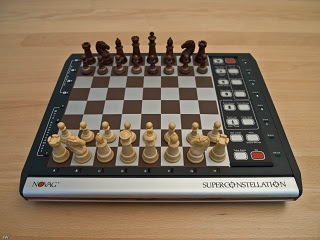
In the days before everyone had computers, if you wanted to play chess, your only option was to play with another person. In the late 1970's Fidelity introduced a series of electronic computer chess games. These early models played poorly, but I knew people who bought them just to be able to play and practice whenever they wanted. I managed to borrow a few of these so that I could get a feel for how well they played.
Although the early machines did not play well, things started to improve in the 1980s. There was a golden age of dedicated chess computers that went from 1983 to about 1993. In 1984, I purchased the Novag Super Constellation electronic chess game for what I think was $200, which was quite a bit of money in 1984. The U.S. Chess Federation had given it a rating of 2018, which is better than at least 90% of all adult tournament players. Any rating between 2000 and 2199 is considered to be the skill level of "Expert" and a higher rating of 2200 is considered to be "Master."
Although I am currently rated 2016, at the time I bought the
Novag Super Constellation I was rated just a little over 1700. In a few months, I would reach a rating of 1800 which is considered to be "Class A." Nevertheless, what I remember about the Novag Super Constellation is that it played better than me, which is surprising since it only contains an 8-bit processor running at just 4 MHZ. That is not very fast compared to modern 64-bit processors with multiple cores running at gigahertz speeds.
Over time, I bought a couple of better chess-playing computers and I have fond memories of practicing with all of them. I sold all these machines when I got a desktop computer in the mid-'90s, but I kind of regret it because they all were fun to play with it.
This became an issue when I was researching these old chess-playing computers where I saw many online claims that these computers were not as good as the ratings that had been assigned to them. For example, I saw the claim that the Novag Super Constellation was only about 1750 strength, and two other computers that I owned rated 2100 and 2265 were also claimed to be weaker than their advertised ratings. None of these claims match my experience, since all of the computers played better than I did.
I was so curious about this that I wanted to get my hands on one of the old chess computers, assuming that one can be found, however unlikely, and see how it compares to my current chess ability. Fortunately, I found software that allows me to emulate dozens of old chess computers on my Windows PC.
In my first game against the emulated Novag Super Constellation on level 1, the lowest level, I was able to win by only the slimmest of margins. I tried the same thing on the Fidelity Designer 2100, a slightly better machine, and I lost. I have no doubt that the other computer I owned, the stronger Fidelity Designer 2265, would stomp me like it used to when I played it 30 years ago. I will confirm this eventually.
So I tested a variety of chess computers with a somewhat difficult chess problem..
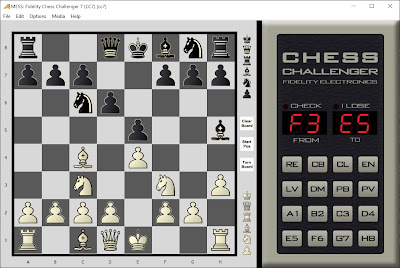
Based upon my testing, this is how long various chess computers take to solve this chess problem...
| # | Model | Year | Processor | Speed | ROM | Time | Depth | Nodes/S |
|---|---|---|---|---|---|---|---|---|
It is noteworthy that the Super Constellation solved the problem in roughly 2 minutes, which is within tournament time controls. I am disappointed in Chessmaster on the Super Nintendo because it failed to achieve this. It is running on a similar processor, and it is a port of Chessmaster 2000 written by Dave Kittinger, who also wrote the Super Constellation program!
* The second version of the Constellation 3.6 solves this problem on its top two tournament levels, but the first version moves too quickly to see the answer. It can only solve the problem on its infinite level, even though it takes about the same amount of time to see the solution. The second ROM set is based upon the Novag Expert program.
Super Constellation game #1.
Subscribe to:
Posts (Atom)