2025-07-20

Testing old chess computers through emulation

In the days before everyone had computers, if you wanted to play chess, your only option was to play with another person. In the late 1970's Fidelity introduced a series of electronic computer chess games. These early models played poorly, but I knew people who bought them just to be able to play and practice whenever they wanted. I managed to borrow a few of these so that I could get a feel for how well they played.

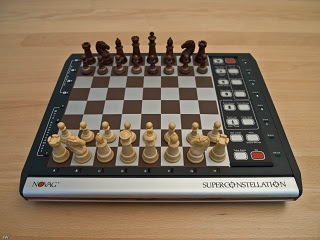
Although the early machines did not play well, things started to improve in the 1980s. There was a golden age of dedicated chess computers that went from 1983 to about 1993.  In 1984, I purchased the Novag Super Constellation electronic chess game for what I think was $200, which was quite a bit of money in 1984. The U.S. Chess Federation had given it a rating of 2018, which is better than at least 90% of all adult tournament players. Any rating between 2000 and 2199 is considered to be the skill level of "Expert" and a higher rating of 2200 is considered to be "Master."

Although I am currently rated 2016, at the time I bought the Novag Super Constellation I was rated just a little over 1700. In a few months, I would reach a rating of 1800 which is considered to be "Class A." Nevertheless, what I remember about the Novag Super Constellation is that it played better than me, which is surprising since it only contains an 8-bit processor running at just 4 MHZ. That is not very fast compared to modern 64-bit processors with multiple cores running at gigahertz speeds.

Over time, I bought a couple of better chess-playing computers and I have fond memories of practicing with all of them. I sold all these machines when I got a desktop computer in the mid-'90s, but I kind of regret it because they all were fun to play with it.

This became an issue when I was researching these old chess-playing computers where I saw many online claims that these computers were not as good as the ratings that had been assigned to them. For example, I saw the claim that the Novag Super Constellation was only about 1750 strength, and two other computers that I owned rated 2100 and 2265 were also claimed to be weaker than their advertised ratings. None of these claims match my experience, since all of the computers played better than I did.

I was so curious about this that I wanted to get my hands on one of the old chess computers, assuming that one can be found, however unlikely, and see how it compares to my current chess ability. Fortunately, I found software that allows me to emulate dozens of old chess computers on my Windows PC.

In my first game against the emulated Novag Super Constellation on level 1, the lowest level, I was able to win by only the slimmest of margins. I tried the same thing on the Fidelity Designer 2100, a slightly better machine, and I lost. I have no doubt that the other computer I owned, the stronger Fidelity Designer 2265, would stomp me like it used to when I played it 30 years ago. I will confirm this eventually.

So I tested a variety of chess computers with a somewhat difficult chess problem..
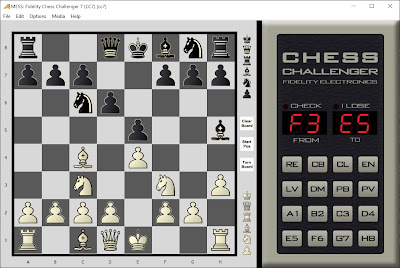


Most serious chess players have seen this problem already and know the answer. However, if they were not familiar with it, the solution might be difficult for them to find in a real game. There is the more direct solution of 6. Nxe5 Bxd1 7. Bxf7+ Ke7 8. Nd5# (checkmate). However, for a computer to see the solution it also has to see 6... Nxe5 7. Qxh5 Nxc4 8. Qb5+ c6 9. Qxc4. There is also 7... Nf6 8. Qe2 Nxc4 9. Qxc4. Either way, that is 7 half-moves deep, which is pretty deep for ancient chess computers to look.

Based upon my testing, this is how long various chess computers take to solve this chess problem...


# Model Year Processor Speed ROM Time Depth Nodes/S
1.
Fidelity Chess Challenger 10
1978
Z80
4 MHZ
4K
Fails
2.
Fidelity Chess Challenger 7
1979
Z80
4 MHZ
4K
12 hours
3.
Novag Savant
1981
Z80
6 MHZ
24K
12:40m
4.
Novag Savant II
1982
Z80
6 MHZ
32K
12:33m
5.
Novag Constellation
1983
6502
2 MHZ
16K
6:46m
6.
Constellation 3.6 ROM set 1
1984
6502
3.6 MHZ
16K
3:30m*
7.
Constellation 3.6 ROM set 2
1986
6502
3.6 MHZ
16K
3:33m*
5 ply
8.
Novag Super Constellation
1984
6502
4 MHZ
56K
2:10m
5 ply
500?
9.
Constellation Expert
1985
65C02
5 MHZ
64K
1:54m
5 ply
10.
Novag Forte A
1986
65C02
5 MHZ
64K
2:15m
5 ply
~1000
11.
Novag Forte B
1986
65C02
5 MHZ
64K
1:58m
5 ply
~1000
12.
Novag Super Forte
1987
65C02
5 MHZ
64K
1:13m
5 ply
~1350
13.
Novag Super Expert A
1987
65C02
5 MHZ
64K
1:00m
5 ply
~1100
14.
Novag Super Forte B
1989
65C02
5 MHZ
64K
30s
5 ply
~1400
15.
Novag Super Expert B
1989
65C02
5 MHZ
64K
19s
5 ply
~1375
16.
Novag Super Forte C
1990
65C02
5 MHZ
64K
11s
5 ply
~1500
17.
Novag Super Nova
1990
HD6301Y
4 MHZ
32K
10s
4 ply
18.
Novag Super Expert C
1990
65C02
5 MHZ
64K
6s
5 ply
~1050
19.
Novag Scorpio 68000
1990
68000
16 MHZ
98K
9s
20.
Novag Diablo 68000
1990
68000
16 MHZ
98K
9s
21.
Fidelity Excellence
1985
65C02
3 MHZ
16K
2:16m
5 ply
22.
Fidelity Excellence
1985
65C02
4 MHZ
16K
2:00m
5 ply
23.
Fidelity Designer Display 2000
1989
65C02
3 MHZ
32K
1:45m
5 ply
~81
24.
Fidelity Par Excellence
1986
65C02
5 MHZ
32K
1:22m
5 ply
25.
Fidelity Designer Display 2100
1988
65C02
6 MHZ
64K
54s
5 ply
~180
26.
Fidelity Designer Display 2265
1989
68000
16 MHZ
64K
5s
3 ply
27.
Fidelity Designer Display 2325
1991
68020
20 MHZ
64K
3s
4 ply
28.
Chessmaster NES
1990
6502
1.79 MHZ
48K
7:00m
5 ply
29.
Chessmaster Super Nintendo
1991
65816
3.58 MHZ
110K
4:43m
5 ply
30.
Chessmaster 2000 (DOS)
1986
?
?
NA
1:33m
31.
Chessmaster 3000 (DOS)
1991
?
?
NA
4s
4 ply
32.
Stockfish 14.1 2017-iMac
2022
i5
3.4 GHZ One Core
NA
<1s
<12 ply
~880,000

It is noteworthy that the Super Constellation solved the problem in roughly 2 minutes, which is within tournament time controls. I am disappointed in Chessmaster on the Super Nintendo because it failed to achieve this. It is running on a similar processor, and it is a port of Chessmaster 2000 written by Dave Kittinger, who also wrote the Super Constellation program!

* The second version of the Constellation 3.6 solves this problem on its top two tournament levels, but the first version moves too quickly to see the answer.  It can only solve the problem on its infinite level, even though it takes about the same amount of time to see the solution. The second ROM set is based upon the Novag Expert program.

Super Constellation game #1.

My USCF rating history graph

This is an interesting graph of my chess rating. The records only go back to 1991.

https://www.uschess.org/datapage/ratings_graph.php?memid=11080847

I first crossed the 1800 rating mark in 1985. However, I was frustrated by my lack of progress until 1988, when I moved near Purdue University. There, I started playing regularly with the Purdue players and running many tournaments, which helped me to improve.

Around 1990, I reached my peak rating of 2079.

After moving to Utah in 1993, my rating dropped back to 1800.  Part of that decline was due to the stress of starting a new job.  Additionally, in the 1990s, there was a perception that Utah players were underrated. This was largely due to the state's relative isolation—traveling to out-of-state tournaments required significant effort, which meant there was less mixing of rating points between regions. I used to drive 420 miles each year to play in the National Open in Las Vegas, which I attended for 12 or 13 consecutive years.

The 1990s also saw deliberate rating deflation by the USCF, following concerns about rating inflation during the 1980s. The USCF aimed to bring its ratings more in line with international ratings, which were generally lower. However, the deflation was so unpopular that the USCF eventually revised its rating system.

Around the year 2000, I set a goal to raise my rating—possibly to master level—by memorizing 200 opening lines. I originally planned to accomplish this in 200 days, but it ended up taking about 400. Then I played in a five-round state championship, and all of my games went out of book by move 5. As a result, I shifted my focus to tactics training. I put a great deal of effort into improving my tactical skills, and my rating began to rise.

I crossed back over 2000 shortly before moving back to Indiana in 2015. In the years leading up to that move, I had several notable tournament results, including winning or tying the Senior Championship four times, winning the state G/60 Championship, and claiming the Expert trophy in the Class Championship.

Magnus Carlsen Ranks Bobby Fischer: Genius, Entertaining, Influence, Sanity