2025-12-07

Black Hangs On

I've gone deep down a rabbit hole on this one.  

It gets way deep, but it illustrates fighting back in a potentially losing position.  I think that this is instructive.

I got started down this path because the computer said that I made the wrong move.  However, I didn't realize just how deep the analysis would get.

https://positionalanalysis.blogspot.com/2025/12/black-hangs-on.html

2025-12-05

Re: Improve Your Chess Tactics

I have uploaded to the website at least a couple of dozen changes to the tactics problems.   Many of these are cosmetic, but I have also fixed a few errors.  

I added one or two new problems.

White to Play

This would seem to be too deep for mere mortals, but not for a world champion.  This was played in 1895, one year after Steinitz lost the world championship to Lasker.

https://positionalanalysis.blogspot.com/2025/10/white-to-play_30.html

I could see Hikaru Nakamura playing something like this.  The weird thing is that he would see it all the way through.

BTW, decades ago I watched Hikaru Nakamura as a child playing in a blitz tournament in Las Vegas.  He beat a grandmaster.

2025-11-21

GM Daniel Naroditsky

I have been waiting to hear the cause of death of 29 year old Grandmaster Daniel Naroditsky.  He was a popular chess Youtuber having made hundreds of videos.

The police said that they were investing his death as a possible suicide or drug overdose.  His family was requesting privacy, so I am not sure if we will hear the official cause of death.

The night before Naroditsky died, he was playing a marathon session almost till morning. He may have been streaming his games at the time.  Reportedly, some of his friends tried to intervene, saying that he was playing himself to exhaustion.  He said that he was fine.

I looked at his history on chess.com.  He lost his last 6 games, which is when he probably decided to stop playing.  In his last game he hung a rook before resigning, which is rare for a Grandmaster.  It probably shows that he was exhausted.  Hanging a rook is an unfortunate way to end one's chess career.

Former world champion Vladimir Kramnik has shown paranoid levels of suspicion about online cheating.  Although online cheating is a problem, Kramnik has accused way more people than what would be reasonable.  He has accused some of the world's best players of cheating.  In particular, he slandered Daniel Naroditsky for over a year in a way that was harmful and Naroditsky said caused him distress.  Many people believed the former world champion.

Although we still don't know the cause of death for Daniel Naroditsky, the world chess federation (FIDE) is considering sanctions against Kramnik for what they perceive as improper behavior.  They even tried to warn Kramnik that he was getting out of line.

--
Best wishes,

John Coffey

http://www.entertainmentjourney.com

2025-11-13

The Type of Chess Problem I Don't Like

White to play and mate in 2


Solution...


I don't particularly like problems with castling as the solution. They feel like trick problems. I was thinking that it was impossible until I realized that White could castle.

There is no reasonable way that you would reach this position in a real game.

2025-11-08

Chess for Babies?


I doubt that babies are capable of abstract thinking.  (BTW, the games on this video are really interesting.)

I remember that at a young age, maybe 9 or 10, I was fascinated with any kind of grid, like a tiled surface.  I would imagine a ball traveling along a diagonal and bouncing off an edge at a right angle and continuing on bouncing off other edges.  This was long before ball and paddle video games were invented that did essentially the same thing.  

My point is that humans have a natural fascination with geometric patterns and chess is a geometric game.

2025-11-02

A World Champion designed this, white to move and win!

https://www.youtube.com/watch?v=1Jc0hDxV_Gs

I would call this a master level endgame.  These corresponding-square problems arise when the king is trying to advance on one of two sides, and the enemy king is trying to guard both sides.  So the two kings do a dance to out maneuver the other.


@john2001plus
0 seconds ago
It was obvious to me that this was a classic corresponding-squares problem. Starting from the left, the Black king must be on b6 when the White king is on c4. If the Black king is on a6 then he is too far left to prevent the White king from marching to h5. From this we obtain five more corresponding squares: the White squares d3, e3, f3, g3, and h4 correspond, respectively, to the Black squares c7, d7 e7, f6, and g6. If it is Black's turn when both kings occupy corresponding squares, Black is forced out of position. 

From that I knew White would need to triangulate at some point, but the actual triangulation move was not obvious to me. Maybe in a real game I would stumble on the correct move. 

The key idea is that after 1. Kb2 Kb8 Black wants to move to a corresponding square after White does. White also wants to move to a corresponding square after Black does. 

Note that 1... Kb7 loses to 2. Kc3 because both players attack two corresponding squares and it is Black who has to move first. This is tricky to see. 

(I'm still trying to wrap my brain around 1. Kb3 Ka7 draws.  After 2.Kc3 Kb7 we have the situation described above where both players attack the same two corresponding squares, but it is White's turn.  Can't White still try to triangulate?  Apparently not.   I need to look at this further.)


So where's the triangulation? 

2. Kc2 Kc8 
(2... Kb7 3. Kc3 is still winning.) 

3. Kd2 Kd8 
Black stays in range of b6. 

4. Kc3 Kc7 
Still keeping in range of b6. 

5. Kd3 
This is the triangulation because Black must still guard b6. Both kings are on their corresponding squares and it is Black's turn 

5... Kd7 
(5... Kb6 6. Ke3 wins on the kingside.) 

6. Kc4.


2025-10-28

Rook and Pawn Ending

I did a detailed analysis of this ending from one of my games.  This is how I have learned most of my endings.  🙂

Some of the lines are complicated.  

With propper play, White can barely hold the draw.


2025-08-22

Little Big Shots: Chess champion Emma Cheng

40% of chess players on chess.com are rated below 480???

https://www.youtube.com/shorts/FQH-GGQPyy8

The ratings used to be different.  I remember having a conversation with a Class A friend 35 yeas ago, who said that anything below 1200 was meaningless, because he reasoned how can you be worse than bad?

However, there were a great many more children who participated in tournaments after that.  This brought the average down by a huge amount.  Kids who had no real concept of how to play chess properly were competing for rating points.

I've talked to adults who have very low ratings on chess.com, like in the 400  to 500 range.  If they are able to find people on their level to play chess with, then more power to them.

It seems like Magnus was being generous.  I see a rating of 800 as a base level competency.   It is really not hard to get 1200 or 1300.  You just have to not make simple mistakes.  Any form of regular tactics study would get a person to that level.

2025-07-20

Testing old chess computers through emulation

In the days before everyone had computers, if you wanted to play chess, your only option was to play with another person. In the late 1970's Fidelity introduced a series of electronic computer chess games. These early models played poorly, but I knew people who bought them just to be able to play and practice whenever they wanted. I managed to borrow a few of these so that I could get a feel for how well they played.

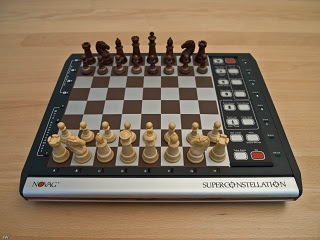
Although the early machines did not play well, things started to improve in the 1980s. There was a golden age of dedicated chess computers that went from 1983 to about 1993.  In 1984, I purchased the Novag Super Constellation electronic chess game for what I think was $200, which was quite a bit of money in 1984. The U.S. Chess Federation had given it a rating of 2018, which is better than at least 90% of all adult tournament players. Any rating between 2000 and 2199 is considered to be the skill level of "Expert" and a higher rating of 2200 is considered to be "Master."

Although I am currently rated 2016, at the time I bought the Novag Super Constellation I was rated just a little over 1700. In a few months, I would reach a rating of 1800 which is considered to be "Class A." Nevertheless, what I remember about the Novag Super Constellation is that it played better than me, which is surprising since it only contains an 8-bit processor running at just 4 MHZ. That is not very fast compared to modern 64-bit processors with multiple cores running at gigahertz speeds.

Over time, I bought a couple of better chess-playing computers and I have fond memories of practicing with all of them. I sold all these machines when I got a desktop computer in the mid-'90s, but I kind of regret it because they all were fun to play with it.

This became an issue when I was researching these old chess-playing computers where I saw many online claims that these computers were not as good as the ratings that had been assigned to them. For example, I saw the claim that the Novag Super Constellation was only about 1750 strength, and two other computers that I owned rated 2100 and 2265 were also claimed to be weaker than their advertised ratings. None of these claims match my experience, since all of the computers played better than I did.

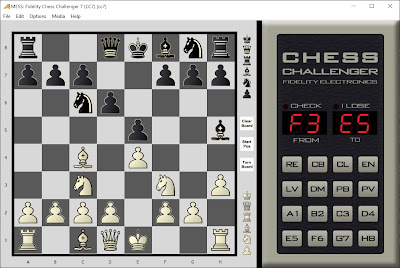
I was so curious about this that I wanted to get my hands on one of the old chess computers, assuming that one can be found, however unlikely, and see how it compares to my current chess ability. Fortunately, I found software that allows me to emulate dozens of old chess computers on my Windows PC.

In my first game against the emulated Novag Super Constellation on level 1, the lowest level, I was able to win by only the slimmest of margins. I tried the same thing on the Fidelity Designer 2100, a slightly better machine, and I lost. I have no doubt that the other computer I owned, the stronger Fidelity Designer 2265, would stomp me like it used to when I played it 30 years ago. I will confirm this eventually.

So I tested a variety of chess computers with a somewhat difficult chess problem..


Most serious chess players have seen this problem already and know the answer. However, if they were not familiar with it, the solution might be difficult for them to find in a real game. There is the more direct solution of 6. Nxe5 Bxd1 7. Bxf7+ Ke7 8. Nd5# (checkmate). However, for a computer to see the solution it also has to see 6... Nxe5 7. Qxh5 Nxc4 8. Qb5+ c6 9. Qxc4. There is also 7... Nf6 8. Qe2 Nxc4 9. Qxc4. Either way, that is 7 half-moves deep, which is pretty deep for ancient chess computers to look.

Based upon my testing, this is how long various chess computers take to solve this chess problem...


# Model Year Processor Speed ROM Time Depth Nodes/S
1.
Fidelity Chess Challenger 10
1978
Z80
4 MHZ
4K
Fails
2.
Fidelity Chess Challenger 7
1979
Z80
4 MHZ
4K
12 hours
3.
Novag Savant
1981
Z80
6 MHZ
24K
12:40m
4.
Novag Savant II
1982
Z80
6 MHZ
32K
12:33m
5.
Novag Constellation
1983
6502
2 MHZ
16K
6:46m
6.
Constellation 3.6 ROM set 1
1984
6502
3.6 MHZ
16K
3:30m*
7.
Constellation 3.6 ROM set 2
1986
6502
3.6 MHZ
16K
3:33m*
5 ply
8.
Novag Super Constellation
1984
6502
4 MHZ
56K
2:10m
5 ply
500?
9.
Constellation Expert
1985
65C02
5 MHZ
64K
1:54m
5 ply
10.
Novag Forte A
1986
65C02
5 MHZ
64K
2:15m
5 ply
~1000
11.
Novag Forte B
1986
65C02
5 MHZ
64K
1:58m
5 ply
~1000
12.
Novag Super Forte
1987
65C02
5 MHZ
64K
1:13m
5 ply
~1350
13.
Novag Super Expert A
1987
65C02
5 MHZ
64K
1:00m
5 ply
~1100
14.
Novag Super Forte B
1989
65C02
5 MHZ
64K
30s
5 ply
~1400
15.
Novag Super Expert B
1989
65C02
5 MHZ
64K
19s
5 ply
~1375
16.
Novag Super Forte C
1990
65C02
5 MHZ
64K
11s
5 ply
~1500
17.
Novag Super Nova
1990
HD6301Y
4 MHZ
32K
10s
4 ply
18.
Novag Super Expert C
1990
65C02
5 MHZ
64K
6s
5 ply
~1050
19.
Novag Scorpio 68000
1990
68000
16 MHZ
98K
9s
20.
Novag Diablo 68000
1990
68000
16 MHZ
98K
9s
21.
Fidelity Excellence
1985
65C02
3 MHZ
16K
2:16m
5 ply
22.
Fidelity Excellence
1985
65C02
4 MHZ
16K
2:00m
5 ply
23.
Fidelity Designer Display 2000
1989
65C02
3 MHZ
32K
1:45m
5 ply
~81
24.
Fidelity Par Excellence
1986
65C02
5 MHZ
32K
1:22m
5 ply
25.
Fidelity Designer Display 2100
1988
65C02
6 MHZ
64K
54s
5 ply
~180
26.
Fidelity Designer Display 2265
1989
68000
16 MHZ
64K
5s
3 ply
27.
Fidelity Designer Display 2325
1991
68020
20 MHZ
64K
3s
4 ply
28.
Chessmaster NES
1990
6502
1.79 MHZ
48K
7:00m
5 ply
29.
Chessmaster Super Nintendo
1991
65816
3.58 MHZ
110K
4:43m
5 ply
30.
Chessmaster 2000 (DOS)
1986
?
?
NA
1:33m
31.
Chessmaster 3000 (DOS)
1991
?
?
NA
4s
4 ply
32.
Stockfish 14.1 2017-iMac
2022
i5
3.4 GHZ One Core
NA
<1s
<12 ply
~880,000

It is noteworthy that the Super Constellation solved the problem in roughly 2 minutes, which is within tournament time controls. I am disappointed in Chessmaster on the Super Nintendo because it failed to achieve this. It is running on a similar processor, and it is a port of Chessmaster 2000 written by Dave Kittinger, who also wrote the Super Constellation program!

* The second version of the Constellation 3.6 solves this problem on its top two tournament levels, but the first version moves too quickly to see the answer.  It can only solve the problem on its infinite level, even though it takes about the same amount of time to see the solution. The second ROM set is based upon the Novag Expert program.

Super Constellation game #1.

My USCF rating history graph

This is an interesting graph of my chess rating. The records only go back to 1991.

https://www.uschess.org/datapage/ratings_graph.php?memid=11080847

I first crossed the 1800 rating mark in 1985. However, I was frustrated by my lack of progress until 1988, when I moved near Purdue University. There, I started playing regularly with the Purdue players and running many tournaments, which helped me to improve.

Around 1990, I reached my peak rating of 2079.

After moving to Utah in 1993, my rating dropped back to 1800.  Part of that decline was due to the stress of starting a new job.  Additionally, in the 1990s, there was a perception that Utah players were underrated. This was largely due to the state's relative isolation—traveling to out-of-state tournaments required significant effort, which meant there was less mixing of rating points between regions. I used to drive 420 miles each year to play in the National Open in Las Vegas, which I attended for 12 or 13 consecutive years.

The 1990s also saw deliberate rating deflation by the USCF, following concerns about rating inflation during the 1980s. The USCF aimed to bring its ratings more in line with international ratings, which were generally lower. However, the deflation was so unpopular that the USCF eventually revised its rating system.

Around the year 2000, I set a goal to raise my rating—possibly to master level—by memorizing 200 opening lines. I originally planned to accomplish this in 200 days, but it ended up taking about 400. Then I played in a five-round state championship, and all of my games went out of book by move 5. As a result, I shifted my focus to tactics training. I put a great deal of effort into improving my tactical skills, and my rating began to rise.

I crossed back over 2000 shortly before moving back to Indiana in 2015. In the years leading up to that move, I had several notable tournament results, including winning or tying the Senior Championship four times, winning the state G/60 Championship, and claiming the Expert trophy in the Class Championship.

Magnus Carlsen Ranks Bobby Fischer: Genius, Entertaining, Influence, Sanity

2025-06-17

Taliban Ban on Chess

 "They shouted at us, they grabbed our chess sets and pieces and they beat up two of my friends," he recalled. One of his friends tried to challenge the men, who work for the ministry for the prevention of vice and promotion of virtue, which upholds the Taliban's hardline interpretation of Islam, as fleshed out in its recent morality laws. He says one of them told him: "Playing chess is forbidden. Buying a chess set is forbidden. Even watching it — is forbidden."

"In short," Hassanzadeh said in a telephone interview, "this healthy and harmless entertainment was snatched away from us."

2025-05-25

Update to my online chess lessons

For those who might be interested, I have updated my online chess lessons.  

I have improved the order of the posts and grouped some items by openings.

https://onethousandpositionstochessmastery.blogspot.com/

2025-04-16

2025-01-22

The Future of Road to GM


@john2001plus
0 seconds ago
Levy,

At 64, soon to be 65, I find that I have a different perspective on things.

I play chess for fun and to learn. I am always learning. If it ever felt like a job, I wouldn't find it worth playing. After all, jobs aren't supposed to be fun.

At my age, I deal with enough minor physical issues that attending tournaments feels like unnecessary work and a time-consuming burden. Unless I were to make significant progress, I have nothing to prove by going to a tournament. I could spend an entire day or weekend at a tournament, possibly gaining 8 rating points, or losing more than that. What would I really accomplish?

Tournaments used to be fun, but they're better suited for younger people with more energy to spare. I haven't given up on tournaments completely, but I'm waiting for the right time.

When I returned to my home state after 22 years, I noticed that many of the players I used to compete against were still playing in tournaments, and their ratings were exactly the same as when I left. My rating had fluctuated quite a bit, but ultimately ended up around the same level. It seemed like we were all chasing a higher rating for 22 years—and making no real progress. That's a lot of effort for no return.

People often go to tournaments thinking they're the key to increasing their rating. But what really matters is whether a person has the skill to reach their goal. Either they have the skill, or they don't. If someone is GM-level, the title will eventually come.

Chess is a game, and like any skill, it can be improved through practice. Some people become exceptional at video games after practicing for hundreds or even thousands of hours. So, I have a theory that I can improve by practicing against the computer and analyzing my games.

I'll let you know if it works.

Best wishes,

John Coffey

2025-01-18

Rod Serling's Greatest Obsession (William Windom)

https://www.youtube.com/watch?v=2aewL16VdsU

The episode starred Wiliam Windom, a character actor who played supporting characters on many old shows.

He is maybe most famous for a Star Trek role...
https://memory-alpha.fandom.com/wiki/William_Windom

"Windom was a tournament chess player... and a life member of the United States Chess Federation"
https://en.wikipedia.org/wiki/William_Windom_(actor)

https://www.uschess.org/msa/MbrDtlMain.php?12546262

Sicilian Defense: Black to Play

Steve,

You might find this interesting.   I wanted to know which line the computer regards as absolutely the best...

https://sicilianopening.blogspot.com/2025/01/black-to-play_27.html

The computer chose either 6. Be3 or 6. e3 following up with 6... e5, which seems counterintuitive. I assume that the Najdorf variation with 6. Bg5 e6 is more common.

These 70-py searches take days to complete.  Often there isn't much difference between 70-ply and 40-ply, but sometimes they are different.  

In the middle game and endgame, there isn't much difference between 30-ply and 40-ply searches, but the opening choices are often different.

2024-12-31

World Blitz Chess Championship Stunning Result

I woke up today feeling like I have a cold or bad allergies, so I spent half the day watching the World Blitz Chess Championship on YouTube, which I probably would have watched anyway.

In a stunning turn of events, Magnus Carlsen and Ian Nepomniachtchi agreed to share the title of World Blitz Chess Champion after three draws in a tie-break playoff. However, the rules state that they had to keep playing until someone won. Magnus suggested that they split the title, Nepomniachtchi agreed, and they asked the arbiter if they could do this. After some behind-the-scenes discussion, it was permitted.

I learned today that these two men have been close friends as well as competitors for decades. Both were born in 1990. This is Nepomniachtchi's first World Championship title.

There is a complicated history behind all this. Magnus Carlsen is widely regarded as the best player to have ever lived, but there are a few players who are close to his level. Magnus has won the classical World Chess Championship five times, defeating Nepomniachtchi twice. However, he decided to stop defending his title. Classical games can be very long, lasting up to six hours each, and the World Championship can be a grueling tournament lasting at least a couple of weeks. Magnus stated that the classical World Championship no longer interests him.

After Magnus, the World Championship title was won by Ding Liren of China and then Gukesh Dommaraju of India.

However, Magnus has continued to participate in rapid and blitz championships. Both tournaments just concluded. Magnus withdrew from the Rapid Championship over a dispute with the organizers due to his violation of the dress code by wearing jeans, which made international news. He initially wasn't going to play in the Blitz Championship, but the parties resolved their differences and even relaxed the dress code for the two-day Blitz championship. I saw many players wearing jeans during the Blitz Championship.

--
Best wishes,

John Coffey

http://www.entertainmentjourney.com

2024-12-12

Ding Liren - Wikipedia

Personal life

He is accompanied by his mother on his travels. In an interview with Die Zeit in February 2024 he said he was dysphoric and had problems sleeping. In November 2024 he was quoted as saying he simply no longer enjoyed his work and suffered psychological problems.

2024-10-26

Cartoon


Thoughts on Getting Better at Chess

Players need to work on tactical pattern recognition and calculation. These are two sides of the same coin. We can't calculate very well unless we can also recognize the patterns on the chessboard.

My personal goal is to be able to either recognize or calculate 3 move tactics while playing speed chess.  I think that there is a difference from 1500 to 2000 where the players go from calculating tactics to recognizing more of them instantly.  Starting in the mid-1990s, I spent a great deal of time studying tactics and this took me from 1800 to 2000.

Many people claim that speed chess is bad, but I don't agree.  It builds pattern recognition and teaches quick calculation, although it depends upon the person.  Speed chess can create bad habits and some people just need more time to calculate.

There is this idea called "The Woodpecker Method" and a book by the same name.  The method is to study the same set of a thousand tactical problems repeatedly.  Each time you do them you will get faster at doing the entire set.  Another author, Michael de La Maza, had the same idea in a book called "Rapid Chess Improvement".  Before he wrote his book, he first published it as an article, but first, he sent the article to me to ask what I thought of it because I had already created a website advocating a similar idea.

I inadvertently discovered this method when I created my chess lesson website around 1996.  The Internet was still very young and there wasn't much chess content so Chess Life magazine gave me an "award" for my site.  After I spent months creating the 1, 2, and 3 move problems on my site, I challenged myself to see how long it would take me to go through each set of the white-to-move and black-to-move problems.  It took a long time.  However, the second and every subsequent pass was faster.  I think that a 2000-level player should be able to get through each set of 1, 2, and 3 move problems in 30 minutes, but only after much practice.  I have achieved this many times, but now I fall short so I intend to study the problems more.

I've been accused of just memorizing the answers to all my problems and not doing any actual tactical calculation.  This is half right.  For some problems, I remember the answers, but for others, I just remember the pattern involved and a few I don't remember at all.  Even if the accusation were 100% correct, this would not be a bad thing.  Chess skill relies on remembering what we have seen before and recognizing those patterns over the board.

Some people improve just by playing a ton of games, and this can work, but I think that it is less effective than studying tactics.  Although most people play a great deal, I don't play many games and prefer to spend my time studying chess.

I also have thoughts on what it takes to become a chess master...

In the late 1970s, I studied basic King and Pawn endgames and became proficient at them.   In the mid-1990s I studied more complex king and pawn endgames, all of which were from my games, and became skilled at those.   I didn't have to memorize these endgames because I understood why the moves were correct.  It is easier to retain information if you understand it, but this is harder to apply to other areas of the game like openings.  I think that endgames are easy to learn, except the more difficult ones like the bishop and knight mate or the queen versus rook ending.

I have a full course covering King and Pawn Endings on my website.

My point is that I think that it is possible to take one small area of the game and master it.  I have done this with King and Pawn Endgames.   Chess is not just one skill, but many, so I think that a person could master chess by just focusing on one aspect of the game until they master it, and then move on to studying a different aspect of the game.  For example, I think that it is possible to learn a particular opening as well as a master, although this would require much effort.

Online ratings mean very little to me.  I can't control how well the anonymous person on the Internet plays or if they are cheating, which many of them do.   What matters to me is how well I play.  Likewise, losing games at the chess club doesn't phase me.  I see losses as an opportunity to learn something.  My goal is to always keep learning.  Losing a game doesn't mean that I am a bad player, and I have confidence in my chess skill.  I have no problem playing and losing to stronger players because my goal is to play the best that I am able regardless of the result.


2024-10-14

Magnus explained why Chess is popular

https://www.youtube.com/shorts/aGc5lYv3cvI

Chess is too complicated for humans to completely master, but Magnus Carlsen has come closer than anyone.

KQ vs. KR Endgame

Recently, I have put much effort into learning the endgame KQ vs. KR. This is probably the most difficult chess endgame to study. Many moves are counterintuitive compared to other endgames where you crowd the enemy king until you get forced checkmate.

It tempting in many positions to check horizontally or vertically.  This is often wrong, and the correct procedure is to check once or twice along a diagonal before checking horizontally or vertically.  In some positions, the best move is to not check but attack the squares around the opponent's king.  To win, you have to be able to calculate well.

Against a good defense, there is a desired position that you must reach to separate the King and Rook.  I note this position on the web page below.

This is also the kind of ending that you might only see twice in a lifetime.  Because of the difficulty, studying it might not be time well spent.  You cannot learn it overnight or just through general principles.

However, I want to be prepared for it.

I have created 33 study positions on the webpage below.  These start with the easiest and progress gradually to the more difficult.  Most problems build upon the ones that came before them.  

If you are interested, scroll down until you see "KQ vs. KR" on the right side.

https://onethousandpositionstochessmastery.blogspot.com/

This is not yet complete.  I plan to add more positions regarding the "3rd rank defense" and how to push the enemy king to the corner.

2024-10-02

Trying out the NEW Internet Chess Club

https://www.youtube.com/watch?v=73oJD5nf3Ok

The different speeds of playing chess from the fastest to the slowest are called:  Bullet, Blitz or Speed Chess, Rapid or Quick Chess, Action Chess (Antiquated.  Between 30 and 59 minutes per player.), Standard, and finally Correspondence or Postal Chess, also known online as Daily.


@john2001plus
9 minutes ago (edited)
As far as I know, ICC was the first place on the Internet to play chess.

I joined ICC back around 1995.  I didn't even have the World Wide Web at that point.  I had used a text-only version of the Internet called "Usenet" for about five years.   Within a few months, I downloaded Netscape and accessed the World Wide Web for the first time.  It was slow and I had no idea what to do with it.  There was hardly any content.

So back then to play chess on ICC you had to download a program that would act as a graphical user interface.  It communicated with the server using text but displayed the board on the screen.  The most popular program was called "Ziics", but it would be later replaced by a program called Blitzn which was the standard until recently.

BTW,  back in the mid-90s, I was having an online chat with the owner of ICC, who told me that he was inventing a new time control, which was less than 3 minutes for the whole game.  He wanted to know if I had any ideas for a name for the new time control.  I tried to come up with something, but he suddenly had an inspiration and called it "bullet".  I told him that this was a terrible name because what do guns have to do with chess?  However, he stuck to his guns, sort of speak.

2024-09-24

Hitler vs Lenin | Chess Game in 1909

https://youtu.be/GYUQYsLWlMI?si=uvwAv7afS2WIOh6E

There is an old story about Hitler and Lenin playing a chess game and there is even a drawing depicting this, but many historians think that it is a myth.

Many famous people played chess. Albert Einstein played Robert Oppenheimer. Mike Tyson played Muhammad Ali. Humphrey Bogart and John Lennon were both officially Experts. Many movie stars would play chess on movie sets while waiting for their scenes, such as John Wayne, Lauren Bacall, and Tony Randall.

Benjamin Franklin was an avid player and met the French master Philidor.

2024-08-14

Magnus on Generational Shifts

This is interesting.  Magnus Carlsen relies a great deal on intuition.  In an interview from about a dozen years ago, he said that he usually sees the best move right away, but still has to calculate to ensure that intuition is correct.   His pattern recognition is the best in the world.  He seems to know more about chess than anyone else.

https://www.youtube.com/shorts/7z3UK3jK77w

Kasparov and Fischer were better at chess calculation than anyone in their generation.  As a result, they tended to play aggressively.  Karpov had a completely different style, where he was a strategic player who relied on being able to outmaneuver his opponents.  Magnus Carlsen can do both, making him a nearly perfect chess player.  

However, in recent years, we have seen the rise of many young players, especially from India and Asia, who could someday become World Champion.

2024-08-03

From a quick tournament

Play online chess

2024-07-27

Symmetrical English Opening

---------- Forwarded message ---------
From: John Coffey <john2001plus@gmail.com>
Date: Sat, Jul 27, 2024 at 6:57 PM
Subject: Symmetrical English Opening
To: Jay, John, Craig


This is the last game I want to share from our group coaching session.

It is most likely the best ten-minute game I have ever played.

https://onethousandpositionstochessmastery.blogspot.com/2024/07/symmetrical-english-opening.html

I am in the process of updating both of my chess lesson websites, which mirror each other.  I plan to drop my web-hosted site next year and stop paying for it because the free blog page is good enough.

On the blog page, I have ordered the games chronologically, which is meant to show the advancement of my playing style over the last 50 years.

I have a detailed endgame lesson I could give some time.  It would take maybe 1.5 to 2.5 hours.

P.S.  Although I have added a bunch of games, both sites contain a bunch of unnecessary posts that I am going to remove.

--
Best wishes,

John Coffey

http://www.entertainmentjourney.com

Slav Defense

I hadn't looked at this game for a very long time, but it is interesting enough that I want to share it.

It is maybe more complicated than most games I share.

https://onethousandpositionstochessmastery.blogspot.com/2024/06/slav-defense.html


--

2024-06-27

Chess Game as best as I can remember

[Event "Columbus Chess Club"]
[Site "Lewellen Chapel"]
[Date "Jun 27, 2024"]
[Round "5"]
[White "Omar"]
[Black "John Coffey"]
[Result "0-1"]

1. d4 Nf6 2. g3 e5 3. dxe5 Ng4 4. e4 d6 5. exd6 Bxd6 6. Nc3 O-O 7. f3 Nxh2 8.
Bf4 Bxf4 9. gxf4 Qh4+ 10. Ke2 Qxf4 11. Qd2 Qxd2+ 12. Kxd2 Nxf1+ 13. Rxf1 Nc6
14. Nd5 Be6 15. Ne2 Rad8 16. c4 Ne5 17. Kc3 g6 (17… Nxc4?? 18. Ne7+ Kh8 19. Rxh7+!) 18. Nef4 Bxd5 19. cxd5 Kg7
0-1 eventually

2024-06-02

Familiar Endgame

I have reached this king and pawn endgame a couple of times, once online and once in a tournament, so I studied it.  I show this endgame in my chess lessons.

https://www.youtube.com/watch?v=e7hhB7Oko2A&t=1941s

The rise of American Hikaru Nakamura

https://www.youtube.com/watch?v=e7hhB7Oko2A&t=1126s

We are also seeing the rise of Indian players.

I watched Nakamura play in a speed chess tournament at the National Open in Vegas when he was 10 to 12 years old.  He beat a Grandmaster.


2024-04-19

2024-03-18

The World's Most Arrogant Chess Player

Chess Puzzles

I've done this problem a few times.  I go back over the problems that I have done before.

This problem has given me some difficulty.  I suppose that it is a relatively simple king chase, but my brain doesn't like to calculate that far ahead.

https://www.chess.com/puzzles/problem/1333863/practice

2024-02-14

Chess IS IN DANGER...

https://www.youtube.com/shorts/6Qw5D8DZMOI

I have no opinion about this whatsoever.  I like chess.com so I am willing to pay for it.  I am also willing to play some on lichess.

2024-01-26

Push to 3000 on chess.com puzzle rating

The puzzle ratings on chess.com don't correspond in any way to USCF ratings.  I complained about this to chess.com, but they responded that their puzzle ratings are where they want to them to be.  (BTW, the upper limit on puzzle ratings is ridiculously high at around 32768.  Some people have actually reached this limit.  For computer nerds like me, this matches the upper limit on a 16-bit signed number.  This tells me that they are using 16 bits to store ratings in their database.)

I wanted to see if I could push my Chess.com puzzle rating up to 3000.  I've been there before, but it is a hard rating to maintain.  

My puzzle rating averaged around 2935.  At this level, I am almost as likely to fail to solve a puzzle as I am to succeed.

I had a theory that if I did enough puzzles I could reach 3000 through a "random walk".   The idea was that if I bounced up and down enough I would eventually hit 3000 through random variation.  This wouldn't mean that I deserve to be at 3000, but got lucky.

It appears to me that chess.com will present puzzles with a sizeable range of difficulty.  This is where luck plays a factor.  However, every time my rating would creep up, I would face problems that seemed too difficult.  This definitely took me out of my comfort zone.

It took me about 2.5 hours to reach 3000.  However, to get there I had to analyze at a deeper level than I am used to.  Whereas the simple chess problems on my website are designed to build pattern recognition, it seems to me that the puzzles on chess.com are more of a measure of how well a person can analyze.  However, pattern recognition is still a factor.

--

2024-01-11

White to play and mate in 2 moves

Composed chess problems often involve zugzwang, which essentially means that after our move every possible move of the opponent leads to a loss.


2024-01-10

HIKARU vs LEVY: EPIC CHESS

https://www.youtube.com/watch?v=eJCHzQpCjSA

@john2001plus
0 seconds ago
I found this very instructive, more than the recap videos.  I would like to see more like this.

2023-12-01

NEW Hans Niemann Chess Cheating Accusations

https://www.youtube.com/watch?v=BJcYMCqCJ2A

Either Hans Nieman is cheating or he soon will become a world top 10 player.

Human beings can be sociopathic, and humans also have a great capacity for delusional thinking.  I have met many narcissistic chess players, and these people can be extremely annoying.  I am pretty sure that narcissism is more common among chess players because competition appeals to people's egos.

This describes Nieman whose egotistical statements have turned opinions against him.  Someone like him might feel entitled to win regardless of ability.  In this case, a person could justify cheating because they think they are not getting the recognition they deserve.  He could be motivated by a desire for acclaim.

I hope Nieman is the next great chess talent, but I don't know if this is true.

If I have time, I will analyze his games from this tournament.

Chess Level 02: Black to play

Fwd: Chess Game

Not a perfect game, but I found it interesting.  Around move 29 I chose to play on the kingside and this plan worked how I intended.

[Event "Columbus Chess Club G/10"]
[Site "Llewellyn Center"]
[Date "2023.11.30"]
[Round "3"]
[White "Coffey, John"]
[Black "Salo, Steve"]
[Result "1-0"]
[WhiteElo "2016"]
[PlyCount "73"]

1. Nf3 c5 2. c4 Nc6 3. Nc3 Nd4 4. Nxd4 cxd4 5. Ne4 e5 6. d3 Nf6 7. Nxf6+ Qxf6
8. g3 b6 9. Bg2 Rb8 10. O-O Bb7 11. e3 Bxg2 12. Kxg2 h5 13. exd4 exd4 14. Re1+
Be7 15. Bf4 Rc8 16. h4 Qc6+ 17. Qf3 Kf8 18. Re4 f6 19. Rxd4 Qxf3+ 20. Kxf3 g5
21. hxg5 fxg5 22. Be5 Rg8 23. Rxd7 Ke8 24. Rxa7 Rf8+ 25. Kg2 Rf7 26. b3 Bc5 27.
Rxf7 Kxf7 28. d4 Be7 29. Rh1 Kg6 30. f4 gxf4 31. gxf4 Rd8 32. Kf3 Rf8 33. Ke4
Bb4 34. Rg1+ Kh7 35. Rg7+ Kh6 36. Rb7 Ba5 37. Bg7+ 1-0

--

2023-11-14

One of my best chess tactics

I consider this to be one of my better chess tactics.  Of course, we have seen Grandmasters like Bobby Fischer make similar moves, so chess masters probably consider this to be pretty routine.

https://onethousandpositionstochessmastery.blogspot.com/2023/11/white-to-play_14.html

The Reason People Don't Get Better At Chess According to Ben Finegold

As a chess YouTuber, Ben Finegold is not my favorite.  His presentation is just not as interesting.  He seems rather casual, less informative, and cocky.  


However, I like the point he makes here, which is that people suck at chess because they blunder and don't learn from their mistakes. 

He is only partially correct.  People try to learn from their mistakes, but they do so by just playing.  It is repeated trial and error.  People don't retain information this way, although if a person played a great deal then they would make progress up to a point, which I think would be around the 1700-1800 level.  It is difficult to get better than this without some serious study.

So the way I learn from my mistakes is that I analyze as many of my games as I have time for, and I have a system for reviewing my past mistakes.  This takes much time, and maybe some people would feel that the time would be better spent just playing.

I strongly believe that studying tactics is critical.  There were specific tactics that I studied that took me from 1800 to 1900, and then a different group of tactics that took me from 1900 to 2000.  I studied tactics 30 minutes a day almost without fail, which meant that I spent hundreds of hours studying tactics.  However, this is something I haven't had time for lately, so my most recent goal is to study tactics for 20 minutes per day.